• Home
  • Music
  • Upcoming Shows
  • Photos
  • Store
  • Press
  • EPK
  • Contact

Lucas Garrett

  • Home
  • Music
  • Upcoming Shows
  • Photos
  • Store
  • Press
  • EPK
  • Contact

LISTEN TO THE NEWEST SINGLE, "MICHIGAN"

Available at all major online distribution sites!

LISTEN

Join the mailing list to gain access to exclusive content!

Welcome

You've reached the official site for Lucas Garrett.  Here you will find music, photos, events, and other related items.  Check back often for new information and updates!

Why I Stopped Making New Year’s Resolutions 

            For many, the end of the calendar year is often packed to the brim with holiday cheer, friends, and family, and there’s a sense of societal pressure that comes with the fanfare. As we stroll past the malaise that can come from self-indulgent overeating and partying with friends and family over the holidays, we’re immediately smacked in the face with New Year’s Eve. Then comes the overabundant pressure that can occur from the New Year’s resolutions that we drum up and feel the need to share with our loved ones.

            How many times have you made a resolution, only to break it by the end of the week? End of the month? Heck, maybe you’re on a good clip this year and make it all the way to April before the resolution breaks. But when it does break, we feel so guilty about it. Why? Why do we, as humans, tend to put so much pressure on ourselves to change, while extending grace to others that don’t? We should extend the grace we give others to ourselves. Recently, I’ve worked hard on fixing the conundrum I’ve faced around the dreaded New Year’s resolution, and a big part of the work was following the advice a friend of mine, Jeff Brisbin, sang in his song, “New Year’s Day.”

            In it, Brisbin pleads “You don’t need a December evening / Times Square or Auld Lang Syne / All you need is to believe that / It’s New Year’s Day all the time.” The words struck me the first time I heard them, and they continue to resonate with me today. 

            Rather than resort to resolution (that alliteration was unintentional, but it made me chuckle!), I have been trying to pivot toward acquiring new hobbies in the new year. That way, if the hobby isn’t enjoyable, I don’t feel guilty about stopping it, and if it is enjoyable, then I have a new way to add fulfillment to my life.

            When it comes to many things in my life, I tend to err on the side of hyperfixation. All too apparent in my past resolution attempts, this proclivity of mine to hyperfixate has a much healthier existence in hobbies. It’s perfectly fine, and much healthier in my opinion, to obsess about a new hobby or entertainment source.

            My newest obsession is the New York Times games. I was suckered in to a dollar a week subscription, and having some money leftover at the year, I found a way to get rid of it! (Who says email advertisements don’t work?!) Now, my nighttime routine is to whip through the various games, tackling the crossword last. Before this hobby, I ran through many origami designs, folding and folding ad nauseum until the mental itch slowly abated. Before that, chess. Other hobbies of mine that I am continually fond of are playing video games and watching the latest show that is all the rage in my family and friends’ circles. 

            There seems to be quite the argument for hobbies helping your health, as well. A study published by Nature Medicine in 2023 has findings that greatly support the idea that having hobbies can be a great way to promote healthy aging. The correlative study didn’t definitively prove the concept, but it showed far and away that those that engaged in hobbies are involving their brains in activities that help to promote mental health and well-being. (You can read the study here.)

            To me, that sounds a lot nicer than subjecting yourself to disparaging thoughts once the resolution or resolutions you claimed to make ultimately — and extremely understandably — snap in half! So, what hobbies do you think you might like to try? I’d love to hear some suggestions!


References

Mak, H.W., Noguchi, T., Bone, J.K. et al. Hobby engagement and mental wellbeing among 

people aged 65 years and older in 16 countries. Nat Med 29, 2233–2240 (2023). 

https://doi.org/10.1038/s41591-023-02506-1
01/02/2026

  • 1 comment
  • Share
    Why I Stopped Making New Year’s Resolutions

    Share link

in Reflections

Burnout, Creativity, and Rest 

For me, music can be one of the best things to experience in this world. Whether I am playing it or enjoying a song on repeat from one of my favorite artists, music can scratch an itch that most other things in my life cannot. That being said, sometimes the scratching of said itch can, at best, lead to a metaphorical dermatitis, and at worst, leave me feeling like I have a figurative gash in my skin.

            So, how does this wide range of emotions related to one thing occur? Personally, I think it is because although music-listening is a big-time hobby of mine — the flipside of that same coin, music-performing, is very much not a hobby. It is a craft. A craft that I’ve poured a large part of my life and soul into. When hobbies and careers meet in one pile, I think it can lead to a higher rate of burnout. Think about it as you address the following question: How many construction workers go home and then watch documentaries on construction?

            I am sure there are some, but my gut instinct tells me the answer is “not many.” Swap out any other career that is not art-related to make a similar analogy, and I bet you would arrive at the same answer.

            What causes the burnout? The answer will range wildly from one musician to another, but a big cause, silly as it may sound, for me is redundant practice. Learning new skills is so gratifying; plateauing at said skill advancement is not. When I first pick up a new technique, it is all I want to practice. At this point, my creativity blossoms, and the technique often spills into new repertoire, which spills into new techniques to be learned! Soon, I find myself prioritizing these techniques in all my practices. Eventually, the metronome hits an upper limit of what I can comfortably play at, despite the initial few weeks of being able to reliably increase the tempo. Then, the plateau kicks in, and I get frustrated.

            Frustration in one’s craft is the antithesis of creativity. Frustration then leads to — you guessed it — burnout! Rather than recognizing the burnout, I then try to shake off the feeling and push through with more practice. From here, the practice sessions become less and less productive, until I finally just stop playing for a little bit. Through all of this, I am still performing live, but I am definitely not improving when I quit practicing.

            A lot of musicians encounter burnout in their craft, but — at least at an anecdotal level — it is rarely discussed. That is one of the reasons the Internet’s ability to make worldwide communities can be so helpful. Scrolling through the reels section of Facebook one day (yes, it was doom scrolling), I found a video from the musician Sophie Burrell. In it, she discusses her problem of getting really good at her instrument, then just abandoning the instrument for a while, only to have to shake off the rust that accumulated from her lack of practice at a later date. If it sounds familiar to what I wrote earlier on, it’s because it is. To see Sophie Burrell’s video on Facebook, click here.

If you are a musician reading this, and both of these accounts sound familiar — good. It means you are not alone, and you are not special in this regard. (I am sure you are special in others, though!) 

From a recent visit with my psychologist (I think everyone should have one, if they can, and that mental health is woefully under-addressed, but that’s a story for another day!), I was given the following information on assessing burnout:

  1. You can't easily shake that temporary feeling of being overwhelmed,
  2. You feel tired almost all the time, so much so that everything feels like [a] chore,
  3. You are more easily irritated, even by things you usually enjoy doing, and
  4. You start questioning the value of what you typically enjoy doing.

Now that we have addressed burnout, how can we reverse it if we are feeling this way?

While the cause of burnout may differ, oftentimes — at least for me — the remedy for it can be the same. Rest. Rest is the best! Holidays are right around the corner; what better time to rest than now? Celebrate the day-to-day with those you love. Watch that dumb movie you have been meaning to watch; bake the dessert that looks way too caloric to be consumed, despite the fact that you would love to eat it; have fun. 

As we grow older, we tend to get so consumed by life that we forget to keep living. Whether it’s a text hanging over our heads, a work problem that follows us home long after we’ve clocked out, or personal drama that doesn’t truly need to exist — it takes two people to have a conflict, after all — the things that truly matter tend to get washed over by unnecessary complications.

I’m not saying that real-life things aren’t happening, I’m saying that we needn’t add more to that noise. Play a game with a loved one; have drinks and conversations with friends and family you haven’t seen in a while. Heck, if you’re a fitness nut, and exercising makes you happy, do more of it (but don’t kill your body in the name of fitness). It is no one’s responsibility to prioritize your happiness and relaxation but yours. Prioritizing the right things (for you) in life, while culling needless things can go a long way in combating burnout. 

To musicians: If you want to play and noodle around on your instrument, but do not want to have strict practice right now, DON’T! There is nothing wrong with noodling around; it can be a great way to de-stress, and sometimes it can facilitate the creation of new music. In other words, noodling around can rest your mind and serve as a way to boon your creativity. 

That technique will be right there waiting to be learned by you tomorrow, the next day, or even the next month! This is something that I’ve been telling myself lately, and slowly I’m beginning to follow my own advice when it comes to burnout. I hope you’re able to get something out of it, too!

11/22/2025

  • Leave a comment
  • Share
    Burnout, Creativity, and Rest

    Share link

in Music

The Rise of AI in Music 

The trend in the music industry for artists to create flawless recordings seems to be growing ever more omnipresent, regardless of genre. Out of time? Quantize it. Not in pitch? Use autotune.

As producers have gone digital, these tools, along with many others, have become the industry standard. These ubiquitous editing tools are taking the imperfection of the recordings further and further out of music. Now, with the growing use of AI, generative and otherwise, there is yet another wrinkle added in the search for musical perfection.

And, before going much further, I will admit to using AI in a recent recording session. While recording drums, my band performed the songs in a live setting. After the performance, AI was utilized to separate the vocals in order for us to have a scratch vocal track to record to. In this sense, AI was very helpful, but I think the distinction must be made that it wasn’t generative AI, nor will the AI-separated vocal be used in the final mix. It was merely used as a placeholder. But what about instances where it’s not used as a placeholder?

Consider the Beatles’ last released song, “Now and Then.” Lennon’s vocal was separated using AI technology to extract it from a very degraded demo recording he had done in the mid-1970s. From there, the remaining Beatles, Paul and Ringo, were able to build the rest of the song. (George’s guitar work from an earlier session of the song in the mid-1990s was also used.) But this case, while much more extensive in its use of AI, is still not an example of generative AI.

So, what is generative AI, and what are some common examples? Generative AI, in terms of music, is when artificial intelligence studies music of the past, learns its patterns, and proceeds to spit out something new while taking these learned algorithms into account. At best, it’s careless; at worst, it’s extremely damaging to the industry.

Tools like Suno (whose tagline is “From your mind to music”) allow anyone with an idea, whether they are musical or not, to “create” a song. Though it is cheapening the craft, I fear that generative AI will soon be as ubiquitous as quantization and autotune. In some ways, society seems to be steering more toward technological creativity, often to the detriment of musical creativity. It is because of this perceived opinion of mine that Jack White’s sentiments during his induction into the Rock and Roll Hall of Fame were so refreshing to me: "And so, to the young artists, I want to say, get your hands dirty and drop the screens and get out in your garage or your little room and get obsessed. Get obsessed with something. You know, get passionate. We all want to share in what you might create. 

Perhaps things are not as gloom and doom as I feel they are


11/16/2025

  • Leave a comment
  • Share
    The Rise of AI in Music

    Share link

in Music

Musical creativity and technological creativity: Can they coexist? 

                  Recently, I stumbled across a video of Charlie Puth making a beat in real-time on The Tonight Show. (For those unaware of the video, they can see it here.) It has seemed to get the attention and awe of many who see the clip. Puth’s talent is undeniable—that’s not what is being called into question here—but I feel the awe may be slightly misplaced. 

                  As Puth is going through the process of making the beat, he says words like “quantize” and phrases like “pitch down” or “pitch up.” Basically, he took a voice memo, slapped it through the computer’s programming (probably GarageBand or Logic Pro), and made a beat using the machine’s algorithms to determine and correct the melody and rhythm. It’s a cool party trick; but it’s not necessarily that innovative or inherently musical. I’d argue it’s more creative.

                  True, Puth needs to understand harmony, and know what is in and out of time (as well as what sibilant sounds might equal different drum parts), but did he actually create . . . anything in this clip? (I’m aware he wrote the song, and Fallon was singing the melody in the voice memo).

                  The question posed points at a larger overall question: What is the line between having creativity and having AI tools (quantization and pitch shifting in this case) assist you in production? How much assistance does it take for something to not really be musically creative, but instead be technologically creative?

                  Then again, it is Charlie Puth. Puth has frequently discussed his trait of having perfect pitch. This trait, along with his clearly vast knowledge of songwriting, harmony, and arrangement has led to him making some pretty remarkable bangers. Take for instance, the song “Changes” (this was the same song featured on the beat-making clip). Puth went on at another time to perform this song with a band and I gotta say, it’s pretty fantastic.

                  I found that performance way more compelling of a video than the one of him using Fallon and a computer to recreate a simple beat and sing the chorus of said song. But I don’t think people will remember the performance video nearly as much; I feel they’re going to remember the party trick one instead. 

                  This hypothesis is arguably supported by YouTube analytics. As I’m writing this post, the performance video of “Changes” has under 270,000 views, while the beat-making video of “Changes” has nearly 4,000,000 views. At the end of the day, in my view, the viral video is nothing more than a gimmick, breaking attention away from Puth’s sublime performance. 

                  What’s more, the gimmick of the video and the technology leveraged traces its roots back to synthesizers and samplings of the late 1970s and early 1980s. I’m reminded of Peter Gabriel’s record, Peter Gabriel IV, and how his team went around junkyards breaking and recording various things breaking. Then, when they had their sounds recorded, they played the keyboard parts using these effects. At the time, that was a pretty badass thing to do. It still is, in my opinion.

                  What are your thoughts? Is musical creativity being hindered by technology? 

11/06/2025

  • Leave a comment
  • Share
    Musical creativity and technological creativity: Can they coexist?

    Share link

in Music

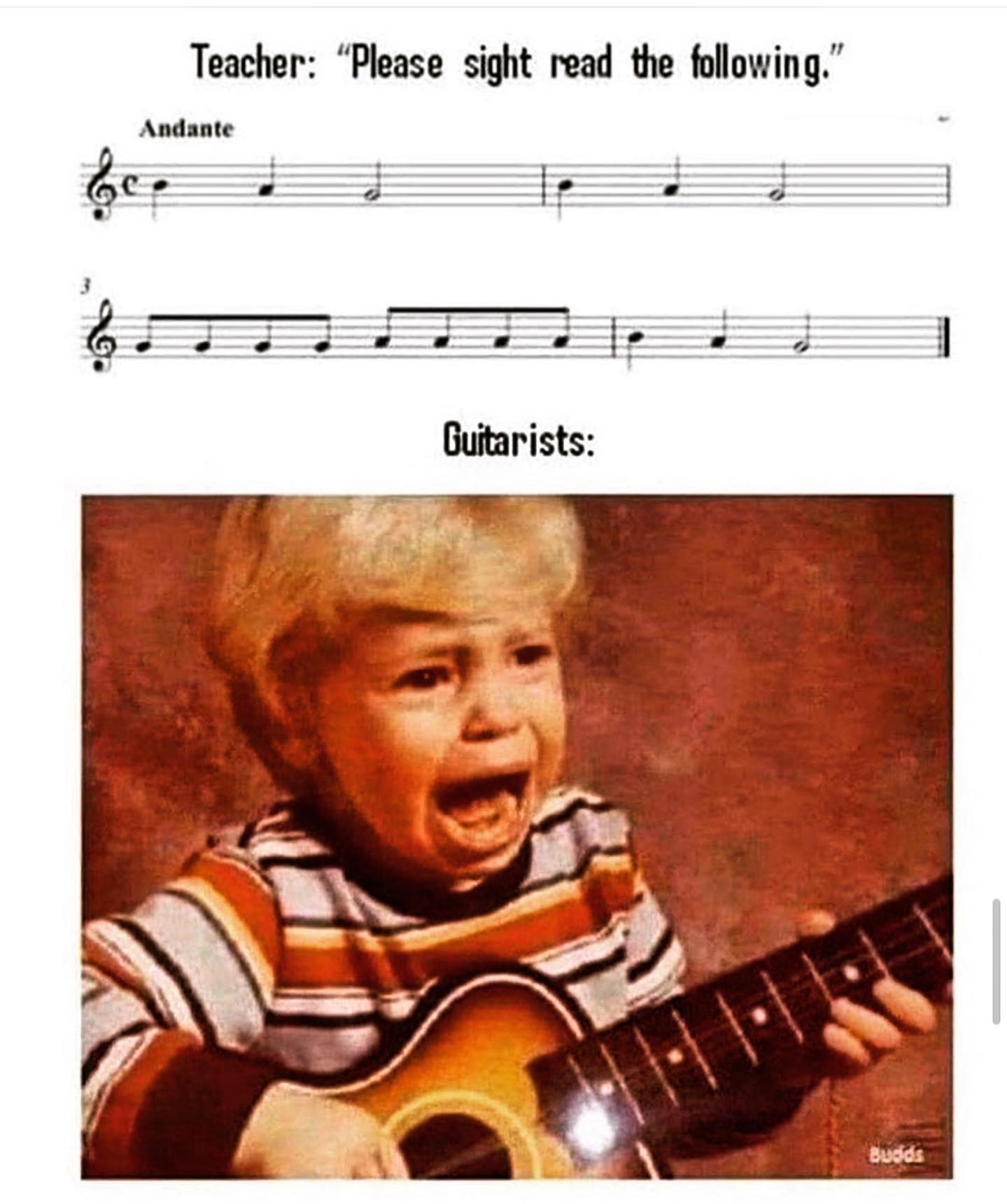
“A guitarist that reads music? Whaaaaa…?” 

“A guitarist that reads music? Whaaaaa…?”

                  I’ve seen these types of memes floating around Internet-land; they always give me a chuckle. I think I may be the demographic they’re poking fun at too: I can write music, but I have the literacy of a middle school band student when it comes to reading it on the fly. But we can work on things that we’re not too good at, thankfully.

                  Lately, I’ve been practicing my music-reading skills and while I haven’t noticed a huge improvement yet, I have been enjoying learning some tunes out of my “Real Book.” It’s not serving as just a paperweight anymore! Success!

                  Life sure is busy, but I’ve been having a good time tacking on 30 minutes or so just trying to pick out a random tune in the book. Better late than never…

                  Many things led to me finally pulling up my breeches and tackling the behemoth of learning this skill of sight-reading that I’ve wanted to learn for a while. One of the more influential pushes toward practicing this was my involvement with Cooper’s Cave Composer Consortium. We just had a concert at the Strand Theater in Hudson Falls, New York, and simply put: it was fantastic. I had the honor of sharing the stage with some of the best musicians in my area; and most of them can read music extremely well.

                  What are some things that you’re not especially good at, but some may consider a regular skill in your career? 

10/30/2025

  • Leave a comment
  • Share
    “A guitarist that reads music? Whaaaaa…?”

    Share link

in Music

Recycled writings and reflections 

A while ago, my friend, author, journalist, jazz fiddler, and all-around badass, Amy Biancolli, suggested I start writing vignettes about my life. Damn the publishing agents, just write! If you know her you can read this last sentence in her voice—I know I can.

Recently I happened upon a short little vignette I wrote years ago. In it, I was discussing a problem of pneumonia. I'll post it bellow, but before I do, I wanted to reflect on a few things:

  1. It's amazing how much changes with time.
  2. It's amazing how LITTLE changes with time. 
    Instead of pneumonia, my health crisis last year was sepsis! Is this a level up? (I think I leveled up!)
  3. What the hell was I doing here? Thank god things are different now.


“…just let me go, already.”


            “…just let me go, already.” The thought kept permeating my brain. An incessant, but quiet nagging at first, that soon swelled to a booming roar. I was 19 years-old at the time and dealing with the worst pneumonia of my life. Sure, I was no stranger to medical mishaps, or battling something severe, but this felt different. Hurt differently. Felt… different. I’d always known up until that point that I would take whatever life had in store for me and deal with it accordingly, but there’s something sobering about drowning in fluids for a week-and-a-half without any signs of letting up.

            “I’d survived intense surgeries, why can’t I handle this?” The thoughts of self-doubt kept swirling around my head in a way that I’d wish upon no one. Perhaps it was my own egotism screaming back at me that caused these sinister introspective thoughts, or perhaps something else. I never figured it out, and I frankly don’t give a fuck what caused those feelings to live. I’ll do everything in my power never to feel that way again. But unfortunately, I was not at a point in my life to realize this.

            “…just let me go, already.” Somehow or another into day eight… nine? Maybe it was day ten of this illness; I found myself saying it aloud. The damnedest thing was: I don’t even really remember saying it. Not really, anyway. Not in a sense that would “hold up in a court,” as the phrase goes. What I do remember was my body seeming to fall through an endless swirl of darkness that was cool yet hot. Uninviting, yet calm. It was the weirdest feeling ever; the crossroads of serenity and fear raced towards me, yet somehow, I was OK with that. “I’d surely suffered enough, no?”

“Not now!” “What the fuck? Who’s that?” The next few moments I can’t quite recall, either, but rather the memory is predicated on recollection by my dear friend, Tarri, who was also my nurse at the time. I cannot imagine what she felt as she heard me mumble again and again, “just let me go,” but what I do remember helps me understand, even if slightly. Rather than remembering saying that sentence, I remember being slapped and jostled awake. It was at this moment I knew I had to fight further. Push harder. As soon as I could, I found the strength to turn the tide, and as evidenced by these writings, I survived. What happened next was what led to a series of delayed downfalls.

            Rather than dealing with this reality, I turned to distractions: college, music, work, relationships. Anything and everything I could do–albeit subconsciously at the time–to avoid mentally dealing with what had occurred. I’ll never forget when the façade of distractions and “I’m OK” type-behavior would come crashing down. All it took was a toxic friendship and emotional bonding–though I admittedly wanted more out of it–to force me to confront it. This girl and I really loved to lean into each other’s wounds and traumas. When we weren’t laughing, we were often drinking. These were in the days that I considered seven to eight shots of liquor a “good start to my evening.” 

            As this connection continued to grow, so too did the toxic co-dependent behaviors. It felt fucking amazing to know someone out there hurt as bad, though differently, as I did. Wonderfully toppling headfirst into depression, I kept drinking. Kept laughing. Kept… avoiding. “Want to go to trivia (and drink)?” “Sure!” “Want to go to the Queensbury (and drink)?” “Hell yeah! Let’s go.” I definitely thought any time spent with her was the best, and I was along for the ride. It wasn’t until that connection snapped in half that I realized I needed to “face the music.” That I’d failed to do so, and that by failing to do so, I off-set my life and made so many things problematic to my personal life. So many things. “I need to change.” “Therapy? No, fuck that, no therapist will know what I’ve gone through.” This debate waged back and forth for a year or so, but as of me writing this I’m still in therapy, and proud of that eventual decision. I realized I needed help. I realized I can’t do things the way I had been doing them. I can only imagine what I’ll realize tomorrow. 

            Since I started truly digging deep, thankfully the “just let me go” sentiment has quelled. I can’t even hear it all, despite any best efforts to hear any sort of its whisper. The whisper I hear in its place, with growing fervor by the day? “Don’t let me go, just let me stay.”

10/23/2025

  • Leave a comment
  • Share
    Recycled writings and reflections

    Share link

Is the method that local musicians use to promote their shows broken? 

As I was scrolling Facebook the other day, I came across a friend's post that discussed the way local musicians market their shows versus the way that well-established artists do. As he said, when it comes time to promote a show, local artists actually promote the venue with the same amount of emphasis as they promote their music. Rarely do you see “[artist name] at [venue name].” It's more of “Enjoy some great service and food while we play!”

I've done the latter way countless times, and so has he. 

The other day, I played a very well-attended show at a local theater, and the marketing behind that event was to promote our music, and our music alone. Then, on Tuesday, I played an event where the show's promotion consisted of talking up the venue's and the performers. However, attendance at the Tuesday show was low!

While the venue did help spread the word about the show on Tuesday, a lot of times I see posts where the musicians are the only ones advertising. It would seem to make sense that both venues AND artists should talk each other up; this is certainly fair if the artist is actively promoting the establishment's food, after all.

Does talking up the venue in local musicians' shows really help the venue? Is there a better way to cross-promote between venue and artist to make it a more symbiotic relationship?

These are just some things I'm thinking about today.

10/16/2025

  • Leave a comment
  • Share
    Is the method that local musicians use to promote their shows broken?

    Share link

Meeting the Legend, Albert Lee 

As a musician, one of the best things for me is going to see awe-inspiring concerts. This past Sunday, January 23rd, certainly did just that. I had the distinct pleasure and honor of seeing Albert Lee perform in Hudson Falls! It was beyond amazing, and I've hardly been able to put my guitar down since. After the concert, I even got to speak with him! We discussed guitar tone, string gauge, and the adverse effects of weather on our hands -- believe me, it's a terribly unfortunate reality. Such a kind, sweet, gentle soul. I am still buzzing and will be for a while!

To think I spent my afternoon listening and talking to someone that's played with Eric Clapton, The Everly Brothers, Emm Lou Harris, and more, is simply mind-boggling! Below are my thoughts on the concert itself!

Lucas Garrett with Albert LeeAs the lights dimmed down with hues of red and blue, audiences that gathered this past Sunday for a matinee The Strand Theatre were gearing up for the masterclass of a lifetime in musicianship. Their teacher, that day, was none other than world-renowned guitarist, Albert Lee. A consummate professional, with a resume no one would dare sneeze at, Lee put on one hell of a show, and then some. Starting the show off was The Strand’s House Band. 

Making their way through select covers of Elvis, The Rolling Stones, Eric Clapton, and The Beatles, The Strand House Band (Marc Clayton and Jonathan Newell on guitar and vocals, Mike Craner on bass and vocals, and Ernie LaRouche on drums), warmed up the audience quickly. 

After a brief intermission, Albert Lee and his band took the stage. Starting right off with “I’m Ready,” Albert dove face first into quite the rollicking number, which all but set the tone for not only the intro, but for most of the concert, as well. Hands gliding up and down the neck of his guitar – with aplomb and skill unparalleled by most – this particular concertgoer couldn’t peel his eyes away. Whatever type of show you may like, frankly put, this show came with no bullshit. No tricks. No frills or flash. Just pure, unadulterated skill, musicality, and fun. 

Wrist locked and firm, all power – in terms of guitar playing – emanating just from Lee’s fingers and fingers alone, Lee also boasted quite the voice. Still strong after all these years, it was a pleasure and honor to hear him and his band make their way through tune after tune, paying homage to many greats within American culture: Carl Perkins, Glen Campbell, and Gram Parsons, to name a few. Lee made sure to play both sides of the pond, however, as he went into a fantastic version of “Tear-Stained Letter” by Richard Thompson near the end of the concert. 

What I really liked about this performance wasn’t just the band, including the rock-solid rhythm section of Jason Smith on drums, and David Chamberlain on bass, as well as the colorful textures of J.T. Thomas on keyboards, but the banter that Albert had as the concert continued. About halfway in to the performance, Lee went on a rather lengthy, comically delivered anecdote about his time with The Everly Brothers, and how it was good that he took the gig of being in their band, as Eric Clapton was getting ready to fire him. Finishing this story off with song, the band went in to the Everly Brothers classic tune, “No One Can Make My Sunshine Smile.” 

Changing things up about halfway through, Lee made his way over to the piano to play a rendition of Jimmy Webb’s “Highwaymen.” There’s a difference between playing the piano and playing the piano. Lee certainly did the latter, begging the question: what can’t this man do? It wasn’t long before he went back to his guitar, however, finishing the afternoon set off with the aforementioned “Tear-Stained Letter,” followed by his tune, “Country Boy.” Damn, what a way to end the show. Bowing and thanking the audience before leaving, it wasn’t long before Albert Lee and the band were back for an encore. 

Sitting at the piano once more, Lee starts back in with Glen Campbell’s “A Better Place,” briefly paying his respects to the legend as the tune concludes. Ending with Johnny Burnette Trio’s “Tear It Up” was a terrific conclusion to a beyond terrific afternoon of music. And, what’s more? He stayed around after the show to speak with concertgoers. An exceedingly humble and gentle soul, it was a pleasure and honor to spend my afternoon listening to Albert Lee. If you ever get a chance to see him perform, do not hesitate: musicians will be in awe – constantly studying his movements and phrasings – and listeners in general will not be able to help but be moved, both literally and figuratively.

01/24/2023

  • 1 comment
  • Share
    Meeting the Legend, Albert Lee

    Share link

Starting a Blog... Who Knows? 

Throughout the years, people have been telling me to put my life and events down in book form. And, while I'm not nearly in a headspace to do that now -- or, realistically ever -- I figured I'd start jotting some recollections down, with no planned frequency. I figured the one below would be an amusing one to start off these writings.

“The thing about driving is…” “you never know what you’re going to hit…” 

            My father has such a weird way with words. His mannerisms have such an ability to catch me off-guard. Combine that with the variety of personalities contained within my group of friends and the interactions that might occur between them, and there’s plenty of gold to mine. 

           Back when I was recording at my friend’s house in Queensbury, I was greeted with just such an occasion. To understand the situation, one needs to know the layout of my friend’s house: a completely accessible basement lay in wait for any that chose to drive around to the back of the building. In order to do so, however, one also needed to navigate the gauntlet of trees and a swimming pool that served as the circuitous path’s borders. On top of that, right on the other side of the trees was a steep – at least thirty-five foot – drop off that looked like Death waiting on the other side for any that might slip down it. 

            While this may seem fairly doable, it was a feat in and of itself to anyone driving something larger than a compact sedan – and certainly more of a feat for someone in a larger-sized minivan. Yes, I know, scooting around in a minivan doesn’t exactly SCREAM “rock n’ roll” aesthetic, but it’s necessary and works well for my family and I, goddammit. 

            Anyway, one night of recording in particular – or perhaps it was for a party being held there; the mind fails to recollect – I ended up going over there with a friend later than normal, and the usual aid of sunlight wasn’t around. On top of that, the trees and bushes hadn’t really been maintained over the course of him living there, so the path continually got smaller. Before long, I started hearing a really “neat” scraping sound along the side of our car. It was one of those sounds where you instantly know what it was without having any experience telling you beforehand what it would sound like. The tree line was wonderfully fighting with the paint on the side of the car, and winning handily. In addition, it had rained the night prior, so the entire pathway was muddy, leaving navigation to be quite delightful. Before long, the car starts sliding and having a mind of itws own. As we’re nearing the final stretch before the basement door is within view, we start slipping right into the beginning of that aforementioned embankment. I believe at the time the Beatles’ “She Loves You” was serving as a very surreal soundtrack to what looked like our demise. We had just gotten SiriusXM and I played the shit out of that particular radio station (Channel 18 forever!) Somehow, however, the car righted itself and we were able to escape death that night. 

            After we finally park near the basement’s entrance and prior to me going into the house, I turn to my dad and before I can say anything, he just calmly says, “The thing about driving is…” and before he could finish his sentiment, my friend in the back seat replies, “You never know what you’re going to hit?” “Yeah, you never know what you’re going to hit,” he exclaimed. And, somehow, it just really summed up something about the experience that I couldn’t help but laugh. I’m still fucking laughing at it.

09/24/2022

  • 1 comment
  • Share
    Starting a Blog... Who Knows?

    Share link

in Music

Some images ©

  • Log out